
On January 24, 2026, the quiet serenity of Laguna Beach became the strategic headquarters for a pivotal moment in the addiction recovery industry. Crystal Cove Recovery, a premier sanctuary for healing and dual diagnosis care, opened its doors to the clinical team from Intervention On Call for an exclusive site visit and collaborative exchange. This was not merely a tour of a facility; it was a “meeting of the minds” designed to fortify the clinical alliance between crisis interventionists and residential treatment providers.
In the high-stakes world of addiction recovery, the “hand-off”, the moment a client moves from a state of crisis in their living room to a bed in a clinical center, is often the most fragile part of the journey. The goal of this meeting was simple yet profound: to bridge that gap with such precision that the continuum of care becomes an unbreakable shield for the families involved.
You can watch the full recap video here.
The Morning Exchange: Clinical Excellence in a Sanctuary Setting
The day commenced with the soft light of a Laguna Beach morning filtering into Crystal Cove’s ocean-view facility. The air was filled with the aroma of fresh coffee and the quiet hum of professionals who spend their lives in the trenches of human crisis. After an intimate meet-and-greet over bagels, the teams embarked on a guided walkthrough of a space that feels less like a hospital and more like a retreat.
At Crystal Cove Recovery, the environment is intentionally designed as a “sanctuary.” This physical space is a critical component of their evidence-based approach to Medical Detox and Residential Treatment. For a client who has spent months or years in the chaos of active addiction, the transition to a clinical setting can be jarring. By providing a peaceful, sanctuary-like atmosphere, Crystal Cove allows the nervous system to begin the process of regulation even before the first therapy session begins.
As the leadership teams from both organizations sat down together, the conversation turned toward the evolving landscape of recovery. They tackled the difficult topics: how to support treatment-resistant clients, how to navigate the complexities of dual diagnosis, and, most importantly, how to handle the growing trend of individuals leaving programs against medical advice (LAMA).
“This place is exceptional,” noted Peg of Peg Interventions. “I’ve been envisioning this day of getting us all together for a long time. It’s about creating a unified knowledge base. When we stand together, families understand that we aren’t just separate entities; we are a unified front against a very powerful disease.”
Insights from the Leadership Teams
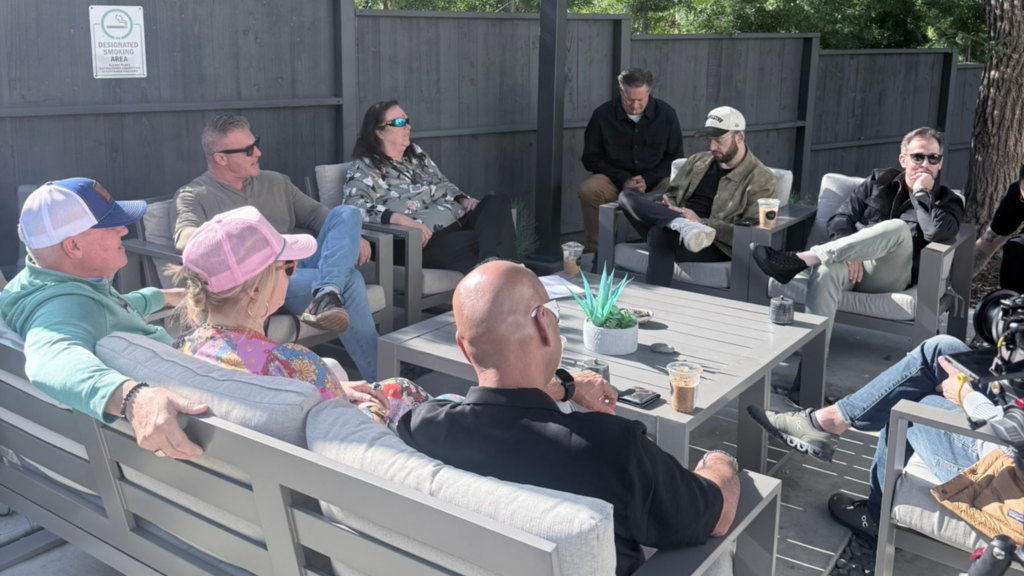
During a deep-dive clinical Q&A, several key members of the Intervention On Call team shared their philosophies. These are professionals who have hand-picked their styles after decades of experience, and their insights provide a roadmap for families who feel they have run out of options.
1. Realigning the Family System: The Invitation to Health
Brian Schultz, joining from Philadelphia, offered a perspective rooted in personal and professional transformation. He challenged the old-school notion that an intervention is a battle of wills. Instead, he views it as a “system realignment.”
Brian’s philosophy centers on the idea that the family unit must move toward health first. The message delivered to the loved one isn’t a threat; it’s an invitation. The family essentially says, “We are getting healthy. We are moving toward a life of recovery. We invite you to come with us, but from this moment on, we will do absolutely nothing to support your active addiction.” This shift removes the pressure from the “event” of the intervention and places it on the “process” of long-term health.
2. Recovery as a Process, Not a Hollywood Script
Scott Stein, representing the Baltimore and Washington D.C. areas, addressed the “Hollywood Myth” of interventions. Many families expect a dramatic, one-time confrontation that “fixes” the problem by sunset. Scott was quick to point out that real magic doesn’t happen in a single afternoon.
True recovery is found in the Continuum of Care—the 30, 60, and 90 days following detox. Scott’s passion lies in case management and ensuring that the boundaries set in the living room are the same boundaries upheld in the treatment center. When the interventionists and the facility are aligned, the “stickiness” of sobriety increases exponentially.
3. Disrupting the Dynamic through Education
From the Pacific Northwest, Matt Brown brought over 20 years of experience to the table. He noted a common frustration: families whose loved ones have been in treatment seven or eight times without success. The missing piece, according to Matt, is often Family Education.
Addiction thrives on enabling, often disguised as love. The Intervention On Call model prioritizes educating the family so they understand the “why” behind the behavior. By “removing the enabling from the fire,” the family creates a dynamic that disrupts the addiction’s ability to survive. Matt emphasized that families can, and should, get into recovery long before their loved one is willing to take that first step.
4. The Three-Pronged Strategic Model
Carlton Norwood of Augusta, Georgia, highlighted the operational structure that makes Intervention On Call unique. He described a three-prong process that guides families from total confusion to a concrete solution:
- Education: Offering free virtual support groups five nights a week to show families they aren’t alone.
- Action: Providing on-demand private sessions where families can build a custom-tailored plan with a professional.
- Solution: Vetting high-tier facilities like Crystal Cove Recovery to ensure that when a client is ready to say “yes,” they are landing in a safe, medically sound environment.
The Common Language of the Spirit and Science
As the clinical exchange drew to a close, Katie Sanders from Atlanta spoke to the “spiritual language” of the work. For many families, by the time they reach out for an intervention, their own power has been completely exhausted.
Katie’s approach is about “planting seeds and picking weeds.” She helps families identify the “delusional thinking” and the “gaslighting” that accompany addiction, not to shame the loved one, but to arm the family with the facts. When families see their experience described in clinical texts, a lightbulb turns on. They realize their experience isn’t unique, which means the solution isn’t a mystery, either.
This is where the synergy with Crystal Cove Recovery becomes vital. While the interventionists manage the “in-the-moment” crisis and the family dynamics, Crystal Cove provides the immediate, medically supervised structure and the long-term dual diagnosis strategies needed to turn that “interruption of behavior” into a brand-new life.
The Evening Session: Forging Lifelong Alliances

The visit concluded with a hosted dinner in the heart of Laguna Beach, allowing the teams to move from clinical protocols to deeper personal connection. As Pesh, the MC for the day, remarked, being an interventionist can often feel like being a “lone wolf.” You are often the only professional in a room full of chaos.
Hand-picked by leadership like Sam Davis, this team ensures that when a family in North Carolina, Georgia, or Philadelphia calls in a panic, they aren’t just getting a voice on a phone, they are getting a direct line to a sanctuary in California that truly knows their name and their mission.
Crystal Cove Recovery remains committed to these high-stakes alliances. We aren’t just a destination for treatment; we are an active partner in a global team dedicated to saving lives. By strengthening the shield between intervention and residential care, we ensure that every family has the best possible chance to reach the other side of addiction: happy, joyous, and free.
If you or a loved one is ready to interrupt the cycle of addiction and step into a life of lasting health, our team is here to help you bridge the gap. Contact Crystal Cove Recovery today to speak with our admissions specialists and discover how our sanctuary in Laguna Beach can become the starting point for your family’s healing.